
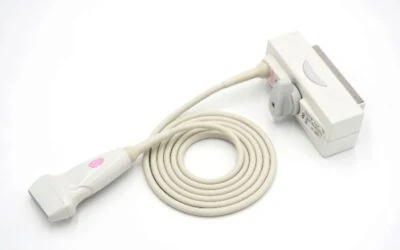
A failing Esaote LA522E does not always mean buying a new probe. Use the fault table below to match what you are seeing on screen to a likely cause, then check what a repair assessment would need.
| Manufacturer | Esaote |
|---|---|
| Model | LA522E |
| Probe type | Linear array |
| Frequency reference | 3.3–10.0 MHz |
| Typical applications | Vascular |
| Compatible systems | Esaote AU3, Esaote AU4, Esaote Caris Plus, Esaote MyLab 15, Esaote MyLab 20, Esaote MyLab 25, Esaote MyLab 30 |
| Source record | ORT Medical product record |
You will usually see the LA522E running on Esaote AU3, Esaote AU4, Esaote Caris Plus, Esaote MyLab 15, Esaote MyLab 20 and other listed systems. Mention the console model with the fault description – connector and revision differences matter.
On linear probes such as the LA522E, superficial imaging workloads put steady stress on the lens membrane and strain relief; the element electronics tend to outlast the mechanical parts.
Common failure modes for the LA522E
Match what you are seeing against the table below. The right-hand column reflects how faults of this kind typically assess – the actual verdict always depends on the individual probe.
| What you see | Likely cause | Typically repairable? |
|---|---|---|
| Whole regions of the image blank across the array width | Widespread element or acoustic stack failure | Usually not economical |
| Pin damage or corrosion visible in the connector | Mechanical damage from forcing or dropping the connector | Usually repairable |
| Strain relief pulling away from the cable or gone rigid | Flex fatigue where the cable meets the probe or connector | Usually repairable |
| Bubbles or lifting at the lens face | Lens delamination from the acoustic stack | Usually repairable |
| Image cuts out when the cable is flexed | One or more conductors broken inside the cable bundle | Case by case |
| Cuts, gouges or discoloration on the lens membrane | Wear from use, or chemical attack from disinfectants | Usually repairable |
| Noticeably weaker penetration than the paired probe | Ageing elements or lens delamination reducing acoustic output | Case by case |
Check these before you ship the probe
- Run the system’s built-in probe test or element check if your console provides one.
- Flex the cable gently along its length while imaging – intermittent dropout points to broken conductors.
- Examine the connector for bent or corroded pins, cracks and a working locking mechanism.
- Check the strain reliefs at both ends for splits, stiffness or separation from the cable.
- Inspect the lens face under good light for cuts, bubbles, lifting edges or discoloration.
Repair, exchange or replace — which applies to your LA522E
Whether a LA522E is worth repairing depends on the damage scope: localized lens, cable, strain relief and connector faults are routine repairs, while widespread element loss usually is not economical. An exchange unit can bridge the gap when downtime matters, and replacement becomes rational when repair cost approaches replacement value. A written assessment settles this per probe – condition, not model, decides it.
What we need to quote your LA522E repair
- A clear photo of the complete manufacturer and model label on the probe
- A description of the fault: what you see on screen and when it started
- The ultrasound system (console) the probe is used with
- Screenshots or photos of the image problem, if the fault is visual
- Photos of any physical damage – lens, housing, cable or connector
Images shown are representative and are not photographs of an individual unit. Nothing on this page claims OEM authorization or guarantees universal fit. Whether a specific LA522E can be repaired, and on what terms, is confirmed in writing once the probe has been assessed.


