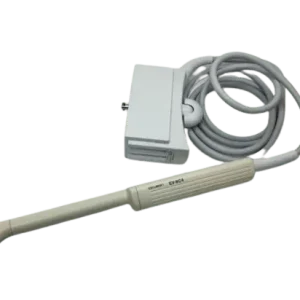
This page covers the GE E8Cs-RS from a repair perspective: the failure modes we see on this class of probe, how to check the probe yourself, and what information gets you an accurate repair quote.
| Manufacturer | GE |
|---|---|
| Model | E8Cs-RS |
| Probe type | Endocavity array |
| Compatible systems | LOGIQ F8, LOGIQ P9 |
In service the E8Cs-RS is most often found on LOGIQ F8, LOGIQ P9. Console-side settings and module revisions still vary, so the exact system build is part of any assessment.
Endocavity probes like the E8Cs-RS live through high-level disinfection cycles that attack seals and the lens; fluid ingress is the fault that ends most of them, which is why leak testing matters.
Common failure modes for the E8Cs-RS
Match what you are seeing against the table below. The right-hand column reflects how faults of this kind typically assess – the actual verdict always depends on the individual probe.
| What you see | Likely cause | Typically repairable? |
|---|---|---|
| Intermittent signal that changes as the cable moves | Broken internal conductors in the cable | Case by case |
| Bent, broken or corroded connector pins | Mechanical damage from forcing or dropping the connector | Usually repairable |
| Strain relief pulling away from the cable or gone rigid | Cable flex fatigue at the probe or connector end | Usually repairable |
| Outer cable sheath showing cracks, kinks or staining | Jacket wear; conductors may still be intact underneath | Usually repairable |
| Depth performance clearly below what this probe used to deliver | Reduced acoustic output from element ageing or a delaminating lens | Case by case |
| Air pockets or peeling visible on the acoustic lens | The lens separating from the acoustic stack underneath | Usually repairable |
| Split seams or impact marks on the probe body | A drop or knock; housings are routinely replaced or resealed | Usually repairable |
| Fluid found inside the probe head after a leak test | Seal failure allowing disinfectant ingress | Case by case |
| Failed electrical leakage test | Compromised sealing on an endocavity probe | Case by case |
Check these before you ship the probe
- Inspect the lens face under good light for cuts, bubbles, lifting edges or discoloration.
- Examine the connector for bent or corroded pins, cracks and a working locking mechanism.
- Run the system’s built-in probe test or element check if your console provides one.
- Compare penetration and uniformity against a known-good probe on the same preset.
- Check the strain reliefs at both ends for splits, stiffness or separation from the cable.
- Have the probe leak-tested before further use – fluid ingress worsens quickly and creates a patient-safety issue.
Repair, exchange or replace — which applies to your E8Cs-RS
Repair suits the E8Cs-RS when damage is mechanical or confined – lens membrane, strain relief, cable jacket, connector hardware. Once element dropout spreads across large sections of the array, repair cost climbs toward replacement value and stops making sense. If uptime is critical, ask about exchange options while your probe is assessed.
What we need to quote your E8Cs-RS repair
- A clear photo of the complete manufacturer and model label on the probe
- A description of the fault: what you see on screen and when it started
- The ultrasound system (console) the probe is used with
- Screenshots or photos of the image problem, if the fault is visual
- Photos of any physical damage – lens, housing, cable or connector
Images shown are representative and are not photographs of an individual unit. Nothing on this page claims OEM authorization or guarantees universal fit. Whether a specific E8Cs-RS can be repaired, and on what terms, is confirmed in writing once the probe has been assessed.