
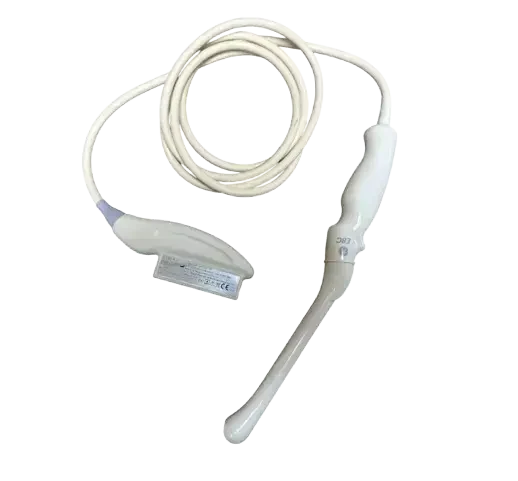
A failing GE 3CRF does not always mean buying a new probe. Use the fault table below to match what you are seeing on screen to a likely cause, then check what a repair assessment would need.
| Manufacturer | GE |
|---|---|
| Model | 3CRF |
| Probe type | Convex array |
| Compatible systems | GE LOGIQ E9, GE LOGIQ S8 |
In service the 3CRF is most often found on GE LOGIQ E9, GE LOGIQ S8. Console-side settings and module revisions still vary, so the exact system build is part of any assessment.
Curved arrays like the 3CRF see heavy abdominal duty, and the curved lens face takes the brunt of it – delamination and membrane wear typically show up before element failures do.
Common failure modes for the 3CRF
Match what you are seeing against the table below. The right-hand column reflects how faults of this kind typically assess – the actual verdict always depends on the individual probe.
| What you see | Likely cause | Typically repairable? |
|---|---|---|
| Connector lock broken or hardware missing | Mechanical damage to the connector shell | Usually repairable |
| Split seams or impact marks on the probe body | A drop or knock; housings are routinely replaced or resealed | Usually repairable |
| Visible nicks, grooves or staining on the lens surface | Mechanical wear or disinfectant damage to the lens | Usually repairable |
| Bubbles or lifting at the lens face | The lens separating from the acoustic stack underneath | Usually repairable |
| Whole regions of the image blank across the array width | Widespread element or acoustic stack failure | Usually not economical |
| Strain relief pulling away from the cable or gone rigid | Cable flex fatigue at the probe or connector end | Usually repairable |
| Pin damage or corrosion visible in the connector | Connector damage from forced insertion or drops | Usually repairable |
Check these before you ship the probe
- Photograph the complete manufacturer label – the exact revision matters for parts compatibility.
- Flex the cable gently along its length while imaging – intermittent dropout points to broken conductors.
- Inspect the lens face under good light for cuts, bubbles, lifting edges or discoloration.
- Examine the connector for bent or corroded pins, cracks and a working locking mechanism.
- Check the strain reliefs at both ends for splits, stiffness or separation from the cable.
Repair, exchange or replace — which applies to your 3CRF
Repair suits the 3CRF when damage is mechanical or confined – lens membrane, strain relief, cable jacket, connector hardware. Once element dropout spreads across large sections of the array, repair cost climbs toward replacement value and stops making sense. If uptime is critical, ask about exchange options while your probe is assessed.
What we need to quote your 3CRF repair
- A clear photo of the complete manufacturer and model label on the probe
- A description of the fault: what you see on screen and when it started
- The ultrasound system (console) the probe is used with
- Screenshots or photos of the image problem, if the fault is visual
- Photos of any physical damage – lens, housing, cable or connector
Images shown are representative and are not photographs of an individual unit. Nothing on this page claims OEM authorization or guarantees universal fit. Whether a specific 3CRF can be repaired, and on what terms, is confirmed in writing once the probe has been assessed.


