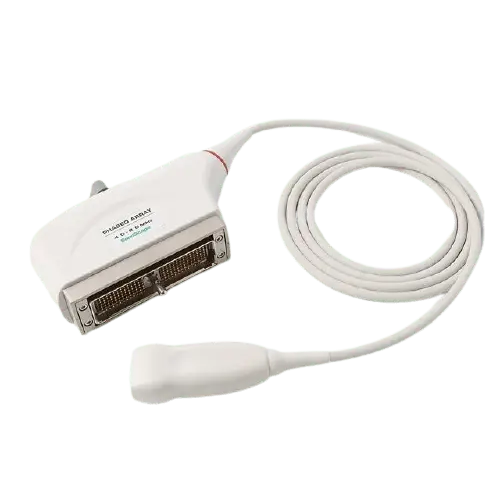
Before writing off a damaged GE S-ACP3-5, compare its symptoms against the failure modes below. Many lens, cable and connector faults on this probe class are economically repairable.
| Manufacturer | GE |
|---|---|
| Model | S-ACP3-5 |
| Probe type | Convex array |
| Compatible systems | GE Voluson 530D, Medison SonoAce SA-9900 |
In service the S-ACP3-5 is most often found on GE Voluson 530D, Medison SonoAce SA-9900. Console-side settings and module revisions still vary, so the exact system build is part of any assessment.
Curved arrays like the S-ACP3-5 see heavy abdominal duty, and the curved lens face takes the brunt of it – delamination and membrane wear typically show up before element failures do.
Common failure modes for the S-ACP3-5
Match what you are seeing against the table below. The right-hand column reflects how faults of this kind typically assess – the actual verdict always depends on the individual probe.
| What you see | Likely cause | Typically repairable? |
|---|---|---|
| Air pockets or peeling visible on the acoustic lens | The lens separating from the acoustic stack underneath | Usually repairable |
| Fuzzy or noisy image that cleaning does not fix | A worn lens surface or elements beginning to degrade | Case by case |
| Image cuts out when the cable is flexed | Broken internal conductors in the cable | Case by case |
| Depth performance clearly below what this probe used to deliver | Ageing elements or lens delamination reducing acoustic output | Case by case |
| Large areas of the array not firing | Extensive element loss across the acoustic stack | Usually not economical |
| Cable jacket cracked, wrinkled or discolored | Surface jacket wear – the conductors inside are often still good | Usually repairable |
| Latch or locking hardware damaged on the connector shell | Mechanical damage to the connector shell | Usually repairable |
Check these before you ship the probe
- Run the system’s built-in probe test or element check if your console provides one.
- Check the strain reliefs at both ends for splits, stiffness or separation from the cable.
- Inspect the lens face under good light for cuts, bubbles, lifting edges or discoloration.
- Compare penetration and uniformity against a known-good probe on the same preset.
- Flex the cable gently along its length while imaging – intermittent dropout points to broken conductors.
Repair, exchange or replace — which applies to your S-ACP3-5
For the S-ACP3-5, think in terms of damage depth: surface and cable-level faults are usually repairable at a fraction of replacement cost; acoustic stack failures are evaluated case by case; extensive element loss generally means replacement. Send the symptoms and photos first – that determines the path before anything ships.
What we need to quote your S-ACP3-5 repair
- A clear photo of the complete manufacturer and model label on the probe
- A description of the fault: what you see on screen and when it started
- The ultrasound system (console) the probe is used with
- Screenshots or photos of the image problem, if the fault is visual
- Photos of any physical damage – lens, housing, cable or connector
Product imagery on this page is representative of the S-ACP3-5 probe family and is not a photograph of your specific unit. This page does not claim OEM authorization or universal compatibility. Repair feasibility, turnaround and commercial terms are confirmed in writing after assessment of the actual probe.