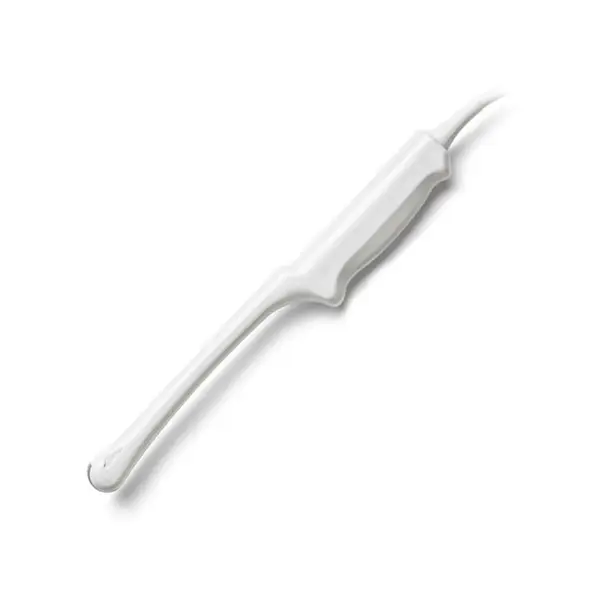
This page covers the Hitachi Aloka EUP-CC531S from a repair perspective: the failure modes we see on this class of probe, how to check the probe yourself, and what information gets you an accurate repair quote.
| Manufacturer | Hitachi Aloka |
|---|---|
| Model | EUP-CC531S |
| Probe type | Endocavity array |
| Compatible systems | Hitachi Hi Vision Avius |
You will usually see the EUP-CC531S running on Hitachi Hi Vision Avius. Mention the console model with the fault description – connector and revision differences matter.
Endocavity probes like the EUP-CC531S live through high-level disinfection cycles that attack seals and the lens; fluid ingress is the fault that ends most of them, which is why leak testing matters.
Common failure modes for the EUP-CC531S
Match what you are seeing against the table below. The right-hand column reflects how faults of this kind typically assess – the actual verdict always depends on the individual probe.
| What you see | Likely cause | Typically repairable? |
|---|---|---|
| Whole regions of the image blank across the array width | Widespread element or acoustic stack failure | Usually not economical |
| Fuzzy or noisy image that cleaning does not fix | Lens wear or early element degradation | Case by case |
| Connector lock broken or hardware missing | Mechanical damage to the connector shell | Usually repairable |
| Air pockets or peeling visible on the acoustic lens | The lens separating from the acoustic stack underneath | Usually repairable |
| Pin damage or corrosion visible in the connector | Connector damage from forced insertion or drops | Usually repairable |
| Visible nicks, grooves or staining on the lens surface | Mechanical wear or disinfectant damage to the lens | Usually repairable |
| Cracked or dented housing | A drop or knock; housings are routinely replaced or resealed | Usually repairable |
| Fluid found inside the probe head after a leak test | Seal failure allowing disinfectant ingress | Case by case |
| Failed electrical leakage test | Compromised sealing on an endocavity probe | Case by case |
Check these before you ship the probe
- Examine the connector for bent or corroded pins, cracks and a working locking mechanism.
- Flex the cable gently along its length while imaging – intermittent dropout points to broken conductors.
- Check the strain reliefs at both ends for splits, stiffness or separation from the cable.
- Compare penetration and uniformity against a known-good probe on the same preset.
- Run the system’s built-in probe test or element check if your console provides one.
- Have the probe leak-tested before further use – fluid ingress worsens quickly and creates a patient-safety issue.
Repair, exchange or replace — which applies to your EUP-CC531S
For the EUP-CC531S, think in terms of damage depth: surface and cable-level faults are usually repairable at a fraction of replacement cost; acoustic stack failures are evaluated case by case; extensive element loss generally means replacement. Send the symptoms and photos first – that determines the path before anything ships.
What we need to quote your EUP-CC531S repair
- A clear photo of the complete manufacturer and model label on the probe
- A description of the fault: what you see on screen and when it started
- The ultrasound system (console) the probe is used with
- Screenshots or photos of the image problem, if the fault is visual
- Photos of any physical damage – lens, housing, cable or connector
Images shown are representative and are not photographs of an individual unit. Nothing on this page claims OEM authorization or guarantees universal fit. Whether a specific EUP-CC531S can be repaired, and on what terms, is confirmed in writing once the probe has been assessed.