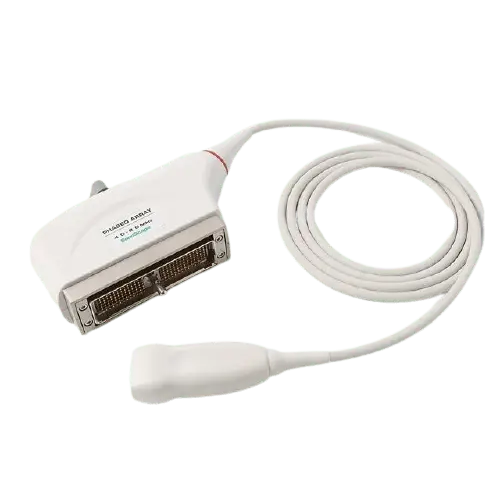
The SIUI L10LC is a common candidate for repair rather than replacement. This page lists its typical failure modes, self-checks you can run, and the details a repair lab needs from you.
| Manufacturer | SIUI |
|---|---|
| Model | L10LC |
| Probe type | Linear array |
| Compatible systems | SIUI Apogee 5300 |
The L10LC typically pairs with SIUI Apogee 5300; the same fault can present differently between console revisions, which is why the host system is asked for with the quote details.
Linear arrays like the L10LC concentrate wear at the lens edges and the cable exit – shallow, high-frequency work means constant handling, and the first faults are usually mechanical rather than acoustic.
Common failure modes for the L10LC
Match what you are seeing against the table below. The right-hand column reflects how faults of this kind typically assess – the actual verdict always depends on the individual probe.
| What you see | Likely cause | Typically repairable? |
|---|---|---|
| Intermittent signal that changes as the cable moves | One or more conductors broken inside the cable bundle | Case by case |
| Dark bands or dropout lines in the image | Element dropout, or a conductor break inside the cable | Case by case |
| Connector lock broken or hardware missing | Broken locking mechanics on the connector housing | Usually repairable |
| Cuts, gouges or discoloration on the lens membrane | Mechanical wear or disinfectant damage to the lens | Usually repairable |
| Whole regions of the image blank across the array width | Extensive element loss across the acoustic stack | Usually not economical |
| Cracked or dented housing | A drop or knock; housings are routinely replaced or resealed | Usually repairable |
| Bent, broken or corroded connector pins | Connector damage from forced insertion or drops | Usually repairable |
Check these before you ship the probe
- Flex the cable gently along its length while imaging – intermittent dropout points to broken conductors.
- Compare penetration and uniformity against a known-good probe on the same preset.
- Run the system’s built-in probe test or element check if your console provides one.
- Inspect the lens face under good light for cuts, bubbles, lifting edges or discoloration.
- Photograph the complete manufacturer label – the exact revision matters for parts compatibility.
Repair, exchange or replace — which applies to your L10LC
Three paths apply to a failing L10LC: repair (typical for lens, housing, cable and connector damage), exchange (fastest route back to scanning) or replacement (when the acoustic stack is too far gone). The deciding factors are how much of the array still fires, whether the housing is intact and what downtime costs you. Each probe is judged on its actual condition.
What we need to quote your L10LC repair
- A clear photo of the complete manufacturer and model label on the probe
- A description of the fault: what you see on screen and when it started
- The ultrasound system (console) the probe is used with
- Screenshots or photos of the image problem, if the fault is visual
- Photos of any physical damage – lens, housing, cable or connector
Images shown are representative and are not photographs of an individual unit. Nothing on this page claims OEM authorization or guarantees universal fit. Whether a specific L10LC can be repaired, and on what terms, is confirmed in writing once the probe has been assessed.