
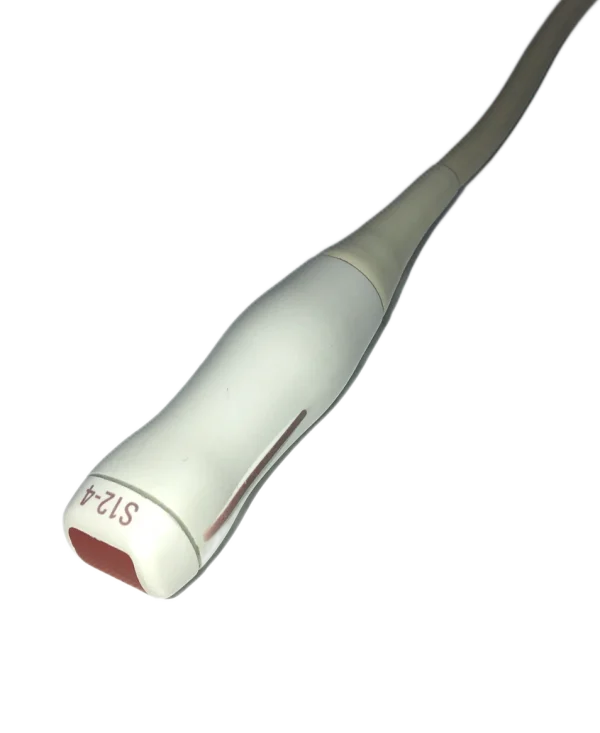
If your Philips S12-4 (21780A) is producing degraded images, failing probe tests or showing physical damage, this page helps you judge what is likely wrong and whether a repair makes sense before you commit to a replacement.
| Manufacturer | Philips |
|---|---|
| Model | S12-4 (21780A) |
| Probe type | Phased Array |
| Compatible systems | Philips HD11, Philips HD11XE, Philips HD15, Philips iE33 |
You will usually see the S12-4 (21780A) running on Philips HD11, Philips HD11XE, Philips HD15, Philips iE33. Mention the console model with the fault description – connector and revision differences matter.
Compact phased-array heads such as the S12-4 (21780A) are sensitive to element dropout at the sector edges, and round-the-clock cardiac use is hard on cables and strain reliefs.
Common failure modes for the S12-4 (21780A)
Match what you are seeing against the table below. The right-hand column reflects how faults of this kind typically assess – the actual verdict always depends on the individual probe.
| What you see | Likely cause | Typically repairable? |
|---|---|---|
| Grainy, low-detail image even after presets are checked | Lens wear or early element degradation | Case by case |
| Vertical shadowing or missing scan lines on screen | Element dropout, or a conductor break inside the cable | Case by case |
| Noticeably weaker penetration than the paired probe | Reduced acoustic output from element ageing or a delaminating lens | Case by case |
| Cuts, gouges or discoloration on the lens membrane | Wear from use, or chemical attack from disinfectants | Usually repairable |
| Latch or locking hardware damaged on the connector shell | Mechanical damage to the connector shell | Usually repairable |
| Whole regions of the image blank across the array width | Extensive element loss across the acoustic stack | Usually not economical |
| Intermittent signal that changes as the cable moves | One or more conductors broken inside the cable bundle | Case by case |
| Sector image narrows or loses the apex | Element failure concentrated at the array edge | Case by case |
Check these before you ship the probe
- Examine the connector for bent or corroded pins, cracks and a working locking mechanism.
- Compare penetration and uniformity against a known-good probe on the same preset.
- Flex the cable gently along its length while imaging – intermittent dropout points to broken conductors.
- Run the system’s built-in probe test or element check if your console provides one.
- Photograph the complete manufacturer label – the exact revision matters for parts compatibility.
Repair, exchange or replace — which applies to your S12-4 (21780A)
Three paths apply to a failing S12-4 (21780A): repair (typical for lens, housing, cable and connector damage), exchange (fastest route back to scanning) or replacement (when the acoustic stack is too far gone). The deciding factors are how much of the array still fires, whether the housing is intact and what downtime costs you. Each probe is judged on its actual condition.
What we need to quote your S12-4 (21780A) repair
- A clear photo of the complete manufacturer and model label on the probe
- A description of the fault: what you see on screen and when it started
- The ultrasound system (console) the probe is used with
- Screenshots or photos of the image problem, if the fault is visual
- Photos of any physical damage – lens, housing, cable or connector
Product imagery on this page is representative of the S12-4 (21780A) probe family and is not a photograph of your specific unit. This page does not claim OEM authorization or universal compatibility. Repair feasibility, turnaround and commercial terms are confirmed in writing after assessment of the actual probe.


