
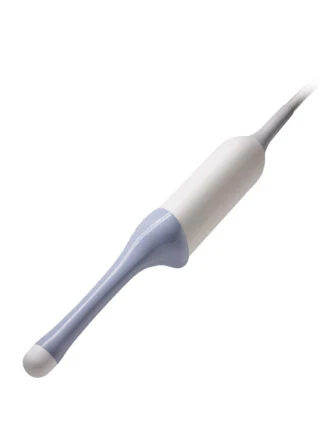
The GE RIC5 is a common candidate for repair rather than replacement. This page lists its typical failure modes, self-checks you can run, and the details a repair lab needs from you.
| Manufacturer | GE |
|---|---|
| Model | RIC5 |
| Probe type | 3D/4D Volume array |
On 4D heads such as the RIC5, the sweeping mechanism is the extra weak point: drive noise, stalled sweeps and chamber issues appear alongside ordinary lens and cable wear.
Common failure modes for the RIC5
Match what you are seeing against the table below. The right-hand column reflects how faults of this kind typically assess – the actual verdict always depends on the individual probe.
| What you see | Likely cause | Typically repairable? |
|---|---|---|
| Visible nicks, grooves or staining on the lens surface | Wear from use, or chemical attack from disinfectants | Usually repairable |
| Vertical shadowing or missing scan lines on screen | Failed transducer elements or a broken conductor in the cable | Case by case |
| Image cuts out when the cable is flexed | Broken internal conductors in the cable | Case by case |
| Latch or locking hardware damaged on the connector shell | Mechanical damage to the connector shell | Usually repairable |
| Outer cable sheath showing cracks, kinks or staining | Jacket wear; conductors may still be intact underneath | Usually repairable |
| Cracked or dented housing | Impact damage; housing can usually be replaced or resealed | Usually repairable |
| Fuzzy or noisy image that cleaning does not fix | Lens wear or early element degradation | Case by case |
| Grinding noise or vibration during volume sweeps | Worn mechanical drive in the volume head | Case by case |
| 4D acquisition stops mid-sweep | Motor or drive electronics fault | Case by case |
Check these before you ship the probe
- Inspect the lens face under good light for cuts, bubbles, lifting edges or discoloration.
- Examine the connector for bent or corroded pins, cracks and a working locking mechanism.
- Compare penetration and uniformity against a known-good probe on the same preset.
- Photograph the complete manufacturer label – the exact revision matters for parts compatibility.
- Flex the cable gently along its length while imaging – intermittent dropout points to broken conductors.
Repair, exchange or replace — which applies to your RIC5
Repair suits the RIC5 when damage is mechanical or confined – lens membrane, strain relief, cable jacket, connector hardware. Once element dropout spreads across large sections of the array, repair cost climbs toward replacement value and stops making sense. If uptime is critical, ask about exchange options while your probe is assessed.
What we need to quote your RIC5 repair
- A clear photo of the complete manufacturer and model label on the probe
- A description of the fault: what you see on screen and when it started
- The ultrasound system (console) the probe is used with
- Screenshots or photos of the image problem, if the fault is visual
- Photos of any physical damage – lens, housing, cable or connector
Images shown are representative and are not photographs of an individual unit. Nothing on this page claims OEM authorization or guarantees universal fit. Whether a specific RIC5 can be repaired, and on what terms, is confirmed in writing once the probe has been assessed.


