
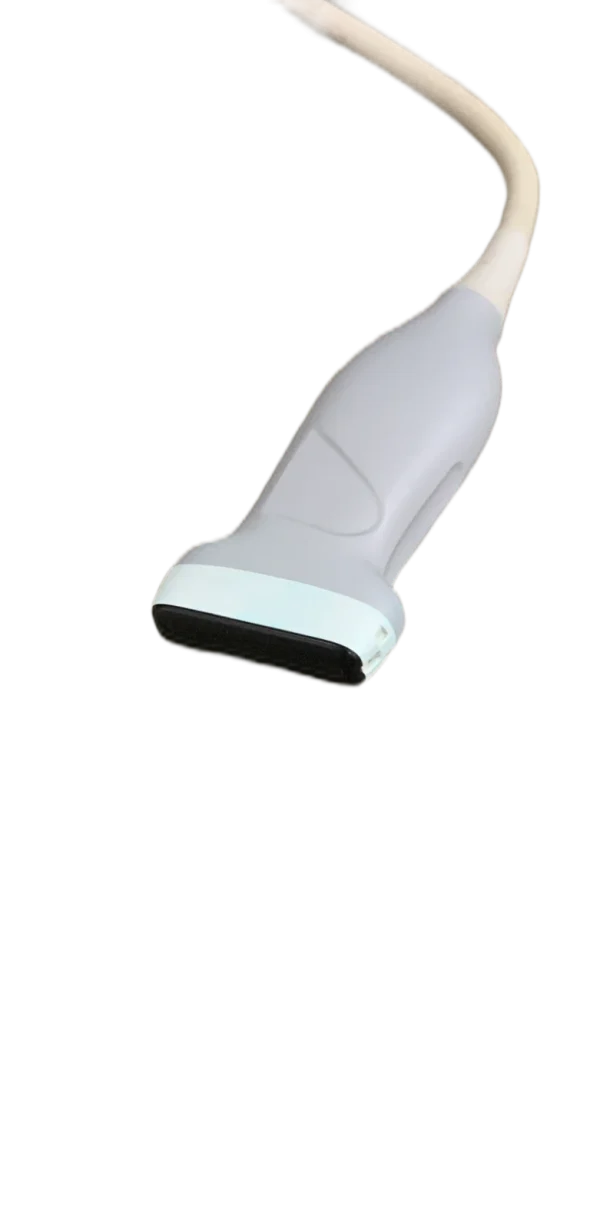
The Samsung L5-13IS is a common candidate for repair rather than replacement. This page lists its typical failure modes, self-checks you can run, and the details a repair lab needs from you.
| Manufacturer | Samsung |
|---|---|
| Model | L5-13IS |
| Probe type | Linear array |
| Compatible systems | Medison Accuvix V10, Medison Accuvix V20, Samsung Accuvix A30, Samsung Accuvix XG, Samsung EKO7 |
In service the L5-13IS is most often found on Medison Accuvix V10, Medison Accuvix V20, Samsung Accuvix A30, Samsung Accuvix XG, Samsung EKO7. Console-side settings and module revisions still vary, so the exact system build is part of any assessment.
Linear arrays like the L5-13IS concentrate wear at the lens edges and the cable exit – shallow, high-frequency work means constant handling, and the first faults are usually mechanical rather than acoustic.
Common failure modes for the L5-13IS
Match what you are seeing against the table below. The right-hand column reflects how faults of this kind typically assess – the actual verdict always depends on the individual probe.
| What you see | Likely cause | Typically repairable? |
|---|---|---|
| Cuts, gouges or discoloration on the lens membrane | Mechanical wear or disinfectant damage to the lens | Usually repairable |
| Cable jacket cracked, wrinkled or discolored | Surface jacket wear – the conductors inside are often still good | Usually repairable |
| Latch or locking hardware damaged on the connector shell | Broken locking mechanics on the connector housing | Usually repairable |
| Intermittent signal that changes as the cable moves | One or more conductors broken inside the cable bundle | Case by case |
| Grainy, low-detail image even after presets are checked | A worn lens surface or elements beginning to degrade | Case by case |
| Split seams or impact marks on the probe body | A drop or knock; housings are routinely replaced or resealed | Usually repairable |
| Strain relief separated, split or stiff | Cable flex fatigue at the probe or connector end | Usually repairable |
Check these before you ship the probe
- Examine the connector for bent or corroded pins, cracks and a working locking mechanism.
- Flex the cable gently along its length while imaging – intermittent dropout points to broken conductors.
- Check the strain reliefs at both ends for splits, stiffness or separation from the cable.
- Photograph the complete manufacturer label – the exact revision matters for parts compatibility.
- Compare penetration and uniformity against a known-good probe on the same preset.
Repair, exchange or replace — which applies to your L5-13IS
For the L5-13IS, think in terms of damage depth: surface and cable-level faults are usually repairable at a fraction of replacement cost; acoustic stack failures are evaluated case by case; extensive element loss generally means replacement. Send the symptoms and photos first – that determines the path before anything ships.
What we need to quote your L5-13IS repair
- A clear photo of the complete manufacturer and model label on the probe
- A description of the fault: what you see on screen and when it started
- The ultrasound system (console) the probe is used with
- Screenshots or photos of the image problem, if the fault is visual
- Photos of any physical damage – lens, housing, cable or connector
Images shown are representative and are not photographs of an individual unit. Nothing on this page claims OEM authorization or guarantees universal fit. Whether a specific L5-13IS can be repaired, and on what terms, is confirmed in writing once the probe has been assessed.


